

Continental MPT vs. Michelin X-Force: Why We Made the Switch on Our EarthRoamer
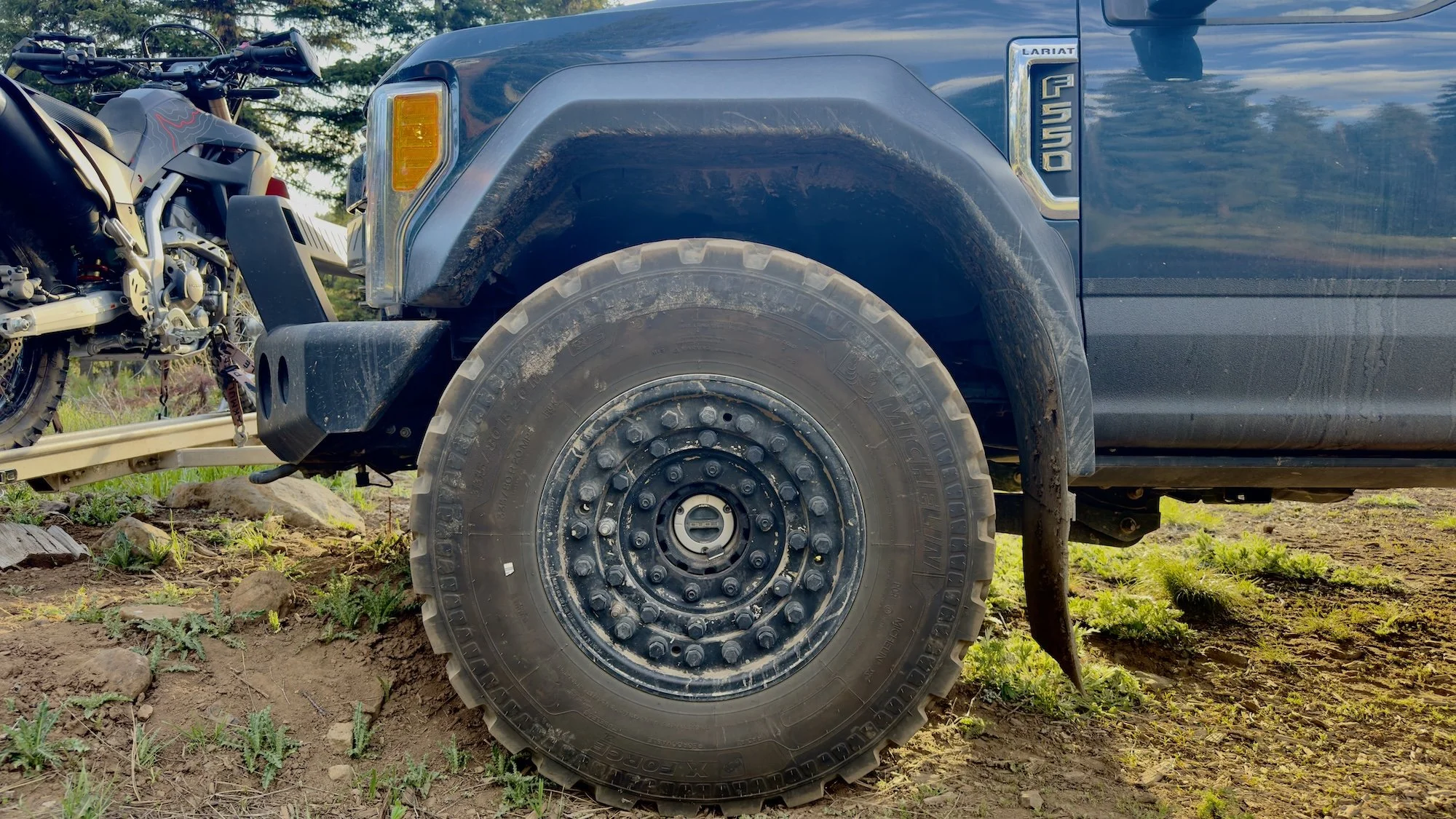
If you run an EarthRoamer, or any serious expedition rig, you already know that tires aren't just a purchase. They're a commitment. They affect your ride quality, your off-road capability, your safety margin, and ultimately your confidence on remote terrain. After spending significant time on the Continental MPT tires in 41", we made the switch to Michelin X-Force tires in 335/80 R20 MPT. Here's everything we learned.
The Continentals: What We Were Running
The Continental MPT is a well-regarded military-spec tire, and for good reason. It's been used on heavy vehicles in demanding conditions for decades. In 41" spec on our EarthRoamer, we ran them at 45 psi front and 90 psi rear on the highway, which is what the load requirements of the rig demanded at those pressures. And they worked. Up to a point.
The Rubber Compound Problem
The biggest issue with the Continentals comes down to their softer rubber compound. On paper, softer rubber means more grip, and it does, in many conditions. But on a heavy vehicle like an EarthRoamer, that softer compound introduces a cascade of other problems.
Cupping
The Continentals were prone to cupping faster than we'd like, which is a wear pattern where sections of the tread wear unevenly, creating a scalloped surface. On a heavy rig, weight distribution and the forces involved accelerate this, and once cupping starts, it compounds quickly.
Lug Tearing on Rocks
This was the one that really got our attention. The softer rubber compound, when dragged across sharp rock edges, doesn't just wear, it tears. We saw lug damage on rocky terrain that we wouldn't expect from a tire marketed as a serious off-road option. Hard, angular rocks essentially peel and shear the softer rubber in ways that a harder compound resists much more effectively.
Heat Management
Running a heavy vehicle at highway speeds generates a lot of heat inside the tire. The Continental's softer compound retains and builds heat in ways that require careful management. On long highway stretches, especially in hot climates, this is a real consideration.
Load Rating
The Continental MPT's load rating in this size came in notably lower than what the Michelin X-Force carries. We weren't able to pin down the exact published figure at the time of writing, so we'd encourage you to pull the spec sheet and compare directly. The difference is meaningful when you're factoring in the weight of a fully loaded EarthRoamer with gear, water, and fuel. Running a tire closer to its load limit compounds every other issue: heat, wear, cupping, and ride quality.
Enter the Michelin X-Force
The Michelin X-Force in 335/80 R20 MPT is also technically a 41" tire, but don't let the matching spec fool you. In person, the Michelin is measurably larger. Same stated size, noticeably bigger footprint and sidewall presence. This matters both on and off road.
Harder Compound, Better Results
Where the Continental's softness caused problems, the Michelin's harder compound solves them. Lug integrity on rocks is dramatically improved. The tread blocks hold their shape and resist tearing far better. Cupping is reduced. And heat management is simply better.
Speed Ratings
The Michelin X-Force carries a higher speed rating than the Continentals, which translates directly to better heat tolerance and structural integrity at highway speeds, exactly where the Continentals were showing their limitations. It’s also a huge win for our speed from one place to the next.
Tire Pressure: A Game Changer
This is where the Michelins made the biggest day-to-day difference for us. On the highway, we now run 35 psi front and 75 psi rear, significantly lower than the 45/90 we needed on the Continentals. Lower pressure means more sidewall flex, more contact patch, and a noticeably more comfortable ride on pavement.
Off-road, you can air them down to whatever the terrain demands. Like any quality all-terrain tire, they shine when you drop the pressure and let the sidewall work.
Snow Ratings
Both the Continental MPT and Michelin X-Force carry the three-peak mountain snowflake (3PMSF) rating, meaning both are certified for severe snow conditions, not just M+S (mud and snow), which is a much lower bar. If you're running through mountain passes or winter terrain in your rig, you're covered on either tire. This wasn't a differentiator for us, but it's worth confirming for your specific size and variant before purchasing.
All-Terrain Capability
Both tires perform well across the full spectrum of terrain: trails, dirt roads, mud, sand. When aired down, both are genuinely capable off-road tires that suit an expedition platform. The gap between these two tires shows up most clearly on the highway and on hard rocky terrain.
One Thing to Watch: Clearance When Lowered Down
The Michelin X-Force, being physically larger than the Continental MPT despite the same stated size, can create clearance issues when the EarthRoamer is in level 1 (lowered past normal drive height). We're talking about the potential to catch your fender when the tire expands and the suspension compresses. We’ve rubbed on our fender, pulling it off the bracket.
Check your fitment carefully before you lower down, especially if you've recently made the switch from Continentals and haven't stress-tested the new tires through full suspension travel.
Our Take: The Michelins Win
After running both tires on the same rig, the Michelin X-Force is the better tire for an EarthRoamer, and likely for most heavy expedition builds.
Here's why, in summary:
Lower operating pressures. 35 psi front / 75 psi rear vs. 45/90 on the Continentals. The ride comfort difference on long highway miles is real and immediate.
Better heat management. The harder compound handles the thermal load of a heavy rig at speed far more effectively.
Superior lug integrity. Rocky terrain no longer chews through our tread blocks the way it did on the softer Continentals.
Higher load capacity. More headroom for a fully loaded rig means less stress on every other system.
Larger real-world footprint. Despite the same nominal size, the Michelins give you more tire where it counts.
Higher speed rating. Even though we don’t ever drive our EarthRoamer fast, it’s nice to be able to keep up with traffic and speed limits. The Continentals had a speed rating of 68 mph but in reality we ended up having to stay more at 60 mph. The Michelins are easily good for prolonged periods of time at 75 mph but can go faster when passing without having to worry about blow outs.
If you're still on Continentals and they're working for you, no reason to panic. But when it's time to replace, we'd strongly recommend making the switch.